Mag. Susanne Winkler
- Function 1
- Photography, City Views (Paintings and Graphic Art), Freemasonry
The approximately 100,000 photographs in the topographical collection of the Wien Museum include examples of early unique processes such as daguerreotype, numerous glass negatives, and a collection of stereoscopic images. The ca. 150 large-format photographs on salt paper, which were taken around 1860 as part of several photographic campaigns by the Imperial Printing Works, are of particular value. These include a panorama of St. Stephen’s Cathedral by Leopold Weiss from 1860 and a documentary record of Vienna’s city wall shortly before its demolition in 1857.
The focus of the topographic photo collection concentrates on architectural and urban photography around 1900. At that time, in the spirit of the emerging idea of historic preservation, the aim of these photographers was to capture any huge urban development transformations in the last third of the 19th century. New possibilities offered by serial production made a huge contribution to the circulation of these photographs. Due to its size, this collection provides — at least for the inner districts — a comprehensive visual documentation of fin-de-siècle Vienna. Many of the most important urban photographers of the time are represented in the collection, including Michael Frankenstein, Franz Holluber, Emil Mayer, Josef Mutterer, Moritz Nähr, Bruno Reiffenstein, Anton Karl Schuster, and Marianne Strobl.
Of particular value is the large collection of work by the Viennese architectural and landscape photographer August Stauda (1861-1927). For more than 20 years, Stauda showed great stamina as he walked Vienna’s streets and took 3,000 photos, capturing the buildings, facades, doorways, courtyards, and, last but not least, the everyday life of the city.
A main feature of the contents from the 20th century is the collection of glass negatives by Martin Gerlach Jr. (1879-1944). Between 1925 and the late 1930s, Gerlach photographed the development of the city on behalf of the municipal authorities, from the public housing of “Red Vienna” to the building of the Höhenstraße. The collection of the actor and cultural historian Fred Hennings (1895-1981) also contains several thousand images of Vienna. As well as being an important collector of topographic images of the city, Hennings also systematically photographed the center of Vienna during the final years of the war, thus creating a record of its condition prior to its partial destruction.
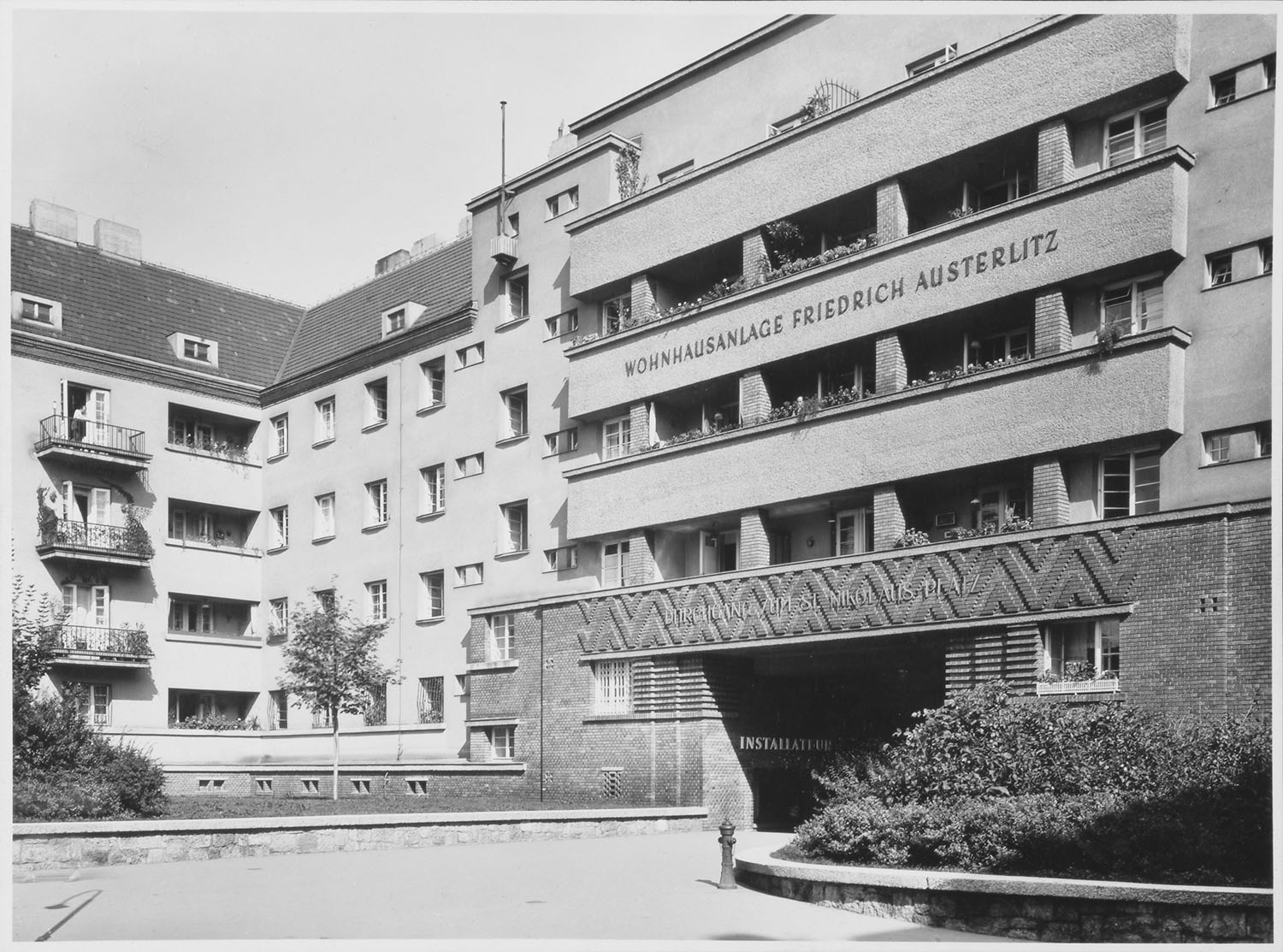
Martin Gerlach Jr.: Rabenhof, 3rd, Baumgasse 29-41, 1933
| Photo: Birgit and Peter Kainz, Wien Museum